
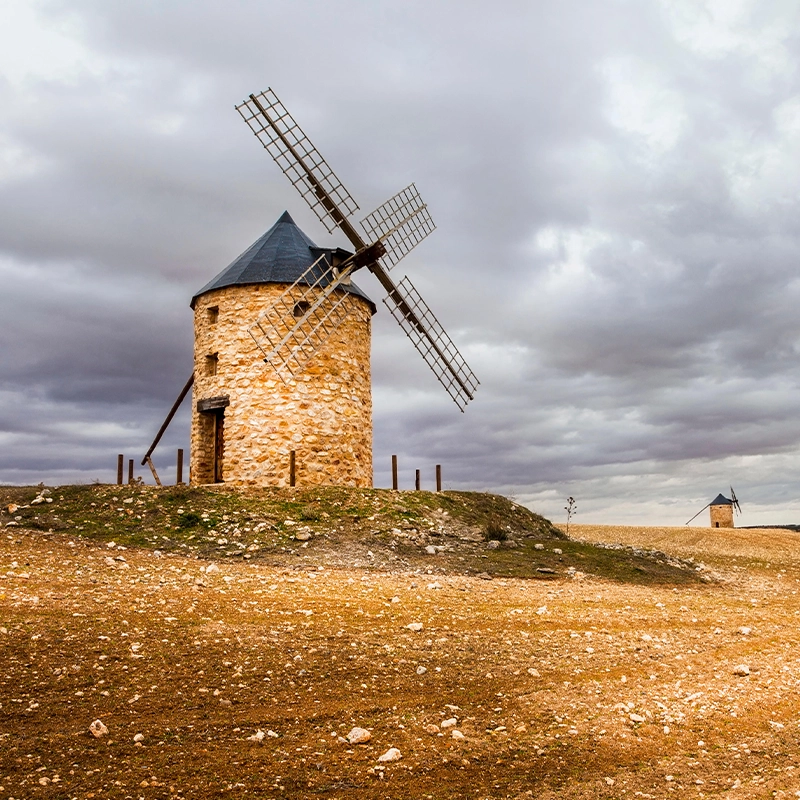
Sufism at the Old Windmill
Each year, as golden fields ripened under the late summer sun, Sheikh Abu Sa’id would lead a caravan of family, disciples, and villagers to a weathered old windmill nestled in the arms of a quiet valley. This was no ordinary errand—it was a journey woven with joy, reverence, and spiritual awakening. The windmill, ancient and solitary, stood like a guard over the surrounding plains, its sails creaking rhythmically as if chanting a silent dhikr in the language of the wind.
This year's harvest was especially bountiful. The fields had given generously, and spirits were high. Though nearly a week on foot and mule, the journey flowed like a hymn—lightened by song, laughter, and the spontaneous sama‘ of Sufi tradition: music, poetry, and the ecstasy of being close to the Beloved.
The caravan finally reached the village, and the villagers gathered to greet the travelers, some offering bread, others simply smiling with the hospitality that only those close to the earth can muster.
As the grain sacks were unloaded and handed over to the old miller, the massive stone wheels of the windmill began to turn. With a low, grinding hum, the mill devoured the wheat and returned it as soft, fragrant flour. The stone—polished smooth by years of labour—caught the afternoon sun and reflected its light like a mirror, throwing flickers of brightness across the faces of the watchers.
Abu Sa’id stood silently, watching the process with luminous eyes. After a while, he turned to his disciples, who had gathered around him.
"Do you hear it?" he asked, his voice soft, yet piercing.
The disciples looked at one another in curiosity.
"The mill is speaking," he continued. "Sufism is what I do. I take the coarse and return it refined. I grind myself to serve others. I spin within myself to remove what does not belong. I wear away my edges to polish what passes through me."
The disciples stood in reverent silence, the metaphor sinking into the soil of their souls. Something stirred in them—an inner recognition of the path they had chosen. The mill was not just grinding wheat—it was teaching them how to grind the self, to transform the ego, to become vessels of refinement.
For three days they stayed in the village, working by day and reflecting by night. The windmill became a symbol of transformation, a silent witness to their inner work.
But on the morning of their departure, as the last sacks of flour were being loaded onto the mules, a great crash shattered the calm. The mill’s stone—its heart—had cracked in two. Dust rose like incense into the air. The villagers gasped. The miller stood frozen.
Yet Abu Sa’id... laughed.
Then he danced.
He spun joyfully, his robe flowing like a prayer in motion. The disciples watched in stunned silence. Had the master misunderstood the gravity of the event?
When he finally sat down, his face was radiant with joy. One of the disciples dared to ask, “Master, the mill stone has broken… why do you rejoice?”
Abu Sa’id’s eyes twinkled as he answered, “Do you not see? That stone spent its life turning round and round, endlessly, with no escape. It lived a life of toil, of circles without end. But today—today—it was freed. It shattered its cycle. It broke its form to release its essence. This is what we must do. We must break the ego that keeps us turning in circles. Only in breaking can we be free.”
The windmill, now silent, had fulfilled its highest purpose—not in grinding grain, but in breaking open a truth.